AI call center technology has moved from buzzword to business essential. Whether you run a growing support team or a full-scale contact center, Why call centers should adopt AI now is clear: it enables faster responses, smarter operations, and a smoother experience for both customers and agents. With voice bot AI handling routine inquiries, your team can focus on more complex issues that need a human touch.
In today’s fast-moving business world, companies are also using modern digital systems and smart computer tools to stay ahead. AI cloud solutions help store and manage data efficiently, while improvements in computer technology make it possible to route calls smarter, predict customer needs, and help agents make better decisions. On the marketing side, businesses are using AI marketing tools and automated customer engagement systems to provide personalized experiences and improve campaigns. Similarly, AI financial tools help companies manage risk, forecast trends, and make smarter business decisions.
By combining these technologies, call centers can run more efficiently, respond faster, and deliver better experiences for both customers and agents.
What Is AI Call Center Technology?
AI call center technology refers to software that uses artificial intelligence and machine learning to automate, assist, and optimize customer interactions across voice and digital channels. It can work alongside human agents or handle certain interactions end to end.
Instead of relying solely on manual processes and static scripts, AI systems learn from data such as call recordings, chat logs, CRM records, and customer feedback. Over time, they become better at understanding customer intent, predicting needs, and recommending the right actions.
Core components of AI in modern call centers
- Natural language understandingthat interprets what customers say or type in everyday language.
- Speech recognitionthat converts spoken words into text for analysis and automation.
- Machine learning modelsthat route calls, suggest responses, and forecast demand based on past patterns.
- Automation enginesthat execute workflows, from resetting passwords to updating orders, without human intervention.
- Analytics and reportingthat transform raw interaction data into actionable insights about performance and customer sentiment.
Top AI Call Center Platforms You Should Know
- Bright Pattern –
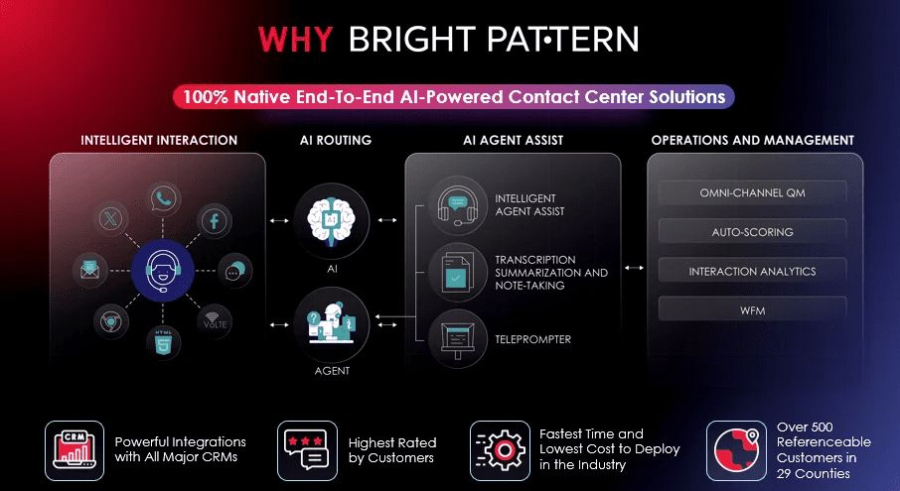
Bright Pattern leads the way in AI call center technology, offering a fully cloud-based platform that integrates voice bot AI, chatbots, and omnichannel support. Its intuitive interface makes it easy for agents to manage multiple channels at once, and AI-driven analytics provide actionable insights to improve customer satisfaction. Bright Pattern also supports advanced routing, automated workflows, and real-time performance monitoring, helping businesses scale quickly while maintaining excellent service. With Bright Pattern, companies can streamline operations, reduce wait times, and ensure that every customer interaction is seamless and personalized.
- Genesys Cloud CX – Offers AI-powered customer experience solutions with omnichannel support and predictive routing.
- Five9 – Provides cloud contact center solutions with intelligent automation and analytics.
- Talkdesk – Features AI-driven insights, workflow automation, and a unified communication platform.
- Zendesk Talk – Combines AI capabilities with a strong help desk and ticketing system.
- Avaya OneCloud – Offers AI-enhanced communication tools and multichannel contact solutions.
- RingCentral Contact Center – Delivers cloud-based AI support and seamless integrations with business tools.
- Freshdesk Contact Center – Provides AI features for ticket automation, chatbots, and performance analytics.
- Cisco Webex Contact Center – Uses AI for analytics, routing, and customer engagement across multiple channels.
Key AI Technologies Powering Call Centers
AI in call centers is not a single tool; it is an ecosystem of capabilities that work together. Here are the main technologies you will see in modern AI enabled contact centers.
1. AI powered IVR and virtual agents
Traditional interactive voice response (IVR) systems rely on menus and keypad options. AI powered IVR and voice virtual agents let customers speak naturally instead of pressing numbers.
- Conversational IVRasks open questions like “How can I help you today?” and understands answers such as “I want to change my plan.”
- Voicebots and chatbotshandle routine tasks such as checking balances, tracking deliveries, and answering common questions.
- Omnichannel virtual agentswork across voice, web chat, messaging apps, and email with consistent logic and personality.
The result is a faster, more natural self service experience that reduces time spent navigating menus and waiting on hold.
2. Intelligent routing and prioritization
Intelligent routing uses AI to connect each customer to the best resource. Instead of simple round robin or skill based rules, AI models evaluate context and probabilities.
- Intent based routingsends billing issues to specialists, technical queries to product experts, and VIP customers to premium queues.
- Data enriched decisionsfactor in customer history, loyalty tier, sentiment, and previous interactions.
- Dynamic prioritizationescalates urgent or at risk customers, such as those expressing frustration or cancellation intent.
This precision routing boosts first contact resolution and reduces transfers, which directly improves customer satisfaction.
3. Agent assist and real time guidance
AI does not just help customers; it also acts as a digital co pilot for agents in live conversations.
- Real time recommendationssuggest next best actions, knowledge base articles, and offers while the customer is still on the line.
- Automatic summarizationcreates concise call notes and dispositions, freeing agents from manual after call work.
- Contextual promptsremind agents about compliance statements, upsell opportunities, or empathy cues based on what the customer says.
This support shortens handle times, improves accuracy, and helps newer agents ramp up faster.
4. Automated quality monitoring and coaching
Traditional quality assurance relies on reviewing a small sample of calls. AI driven quality monitoring can analyze every interaction across channels.
- Speech and text analyticsautomatically flag keywords, topics, and emotional cues such as frustration or satisfaction.
- Compliance checksverify that required disclosures were made and sensitive information was handled correctly.
- Performance insightshighlight coaching opportunities, best practices, and top performing scripts or approaches.
Managers gain a complete view of interactions without spending hours manually listening to calls, and coaching becomes more targeted and data driven.
5. Predictive forecasting and workforce optimization
AI powered forecasting models help you anticipate volume, schedule the right number of agents, and control costs without sacrificing service levels.
- Demand forecastingpredicts contact volume by day, hour, or season, using historical patterns and external factors such as promotions or events.
- Staffing optimizationrecommends shift plans and skill allocations to meet your service targets.
- What if simulationslet you test scenarios such as launching a new product or opening a new channel.
With better forecasting, you can reduce overtime, avoid understaffing, and deliver more consistent service.
Business Benefits of AI Call Center Technology
Adopting AI in your contact center delivers both immediate wins and long term strategic value. Here are the main advantages organizations typically see.
1. Better customer experience
- Shorter wait timesthanks to AI self service, faster routing, and more efficient agents.
- 24 / 7 availabilitywith bots that handle common tasks even when human teams are offline.
- More personalized serviceas AI uses context and history to tailor responses and recommendations.
- Higher first contact resolutionwhen customers reach the right resource with the right information the first time.
Customers feel heard, helped, and valued, which strengthens loyalty and brand reputation.
2. Lower operational costs
- Automation of repetitive tasksreduces the volume of manual work such as status checks, simple updates, and FAQs.
- Higher agent productivitywith AI handling call notes, lookups, and routine workflows.
- Optimized staffingcuts unnecessary labor hours while maintaining or improving service quality.
Organizations often handle more interactions with the same or smaller headcount while unlocking capacity for higher value work.
3. Increased revenue and conversion
- Intelligent cross sell and upsell promptshelp agents recommend relevant add ons or upgrades.
- Proactive outreachuses AI to identify at risk customers or high value prospects to engage at the right moment.
- Smoother purchase journeysreduce friction when customers need help completing transactions.
When customer conversations are more timely and relevant, they naturally lead to more successful sales and renewals.
4. Stronger employee engagement
- Reduced manual drudgeryas AI takes over repetitive tasks and after call work.
- Real time supportgives agents confidence that they have the right answers at their fingertips.
- Data driven coachingprovides clear, fair feedback and growth opportunities.
Agents spend more time solving meaningful problems and less time on busywork, which supports retention and morale.
5. Deeper insight into customers and operations
- Voice of the customer analyticsreveal trends in questions, complaints, and product feedback.
- Performance dashboardsshow how teams, channels, and processes are performing in real time.
- Continuous improvement loopslet you quickly test, learn, and refine scripts, workflows, and policies.
These insights extend beyond the call center, informing decisions in product development, marketing, and customer success.
High Impact Use Cases for AI in Call Centers
AI can support nearly every stage of the customer journey. Below are practical scenarios where organizations see strong, measurable impact.
1. Intelligent self service
Virtual agents and conversational IVR excel at handling high volume, low complexity interactions such as:
- Order status, delivery tracking, and appointment confirmations.
- Account balance checks, subscription details, and plan information.
- Password resets and profile changes with secure verification flows.
- Basic troubleshooting for devices, apps, or services.
By offloading these requests, live agents can focus on complex, emotionally sensitive, or high value interactions.
2. Assisted sales and onboarding
AI guided agents can lead customers through complicated decisions with more confidence and clarity.
- Guided selling flowsrecommend products or plans based on customer needs and past behavior.
- Onboarding assistancewalks new customers through setup steps and helps them realize value quickly.
- Smart follow upsidentify ideal times to check in, offer help, or suggest complementary services.
The result is smoother onboarding, higher adoption, and better long term relationships.
3. Proactive customer care
Instead of only reacting to inbound contacts, AI helps you anticipate needs and act early.
- Detecting signals such as repeated issues or negative sentiment that indicate churn risk.
- Reaching out to customers affected by known incidents with clear, timely updates.
- Offering preventive tips or training when customers struggle with features or processes.
Proactive care reduces escalations and creates a sense of partnership rather than transaction.
4. Service recovery and retention
When something goes wrong, AI can help agents resolve situations quickly and fairly.
- Identifying high priority, high value, or at risk customers in real time.
- Recommending tailored remediation options such as credits, replacements, or upgrades.
- Tracking outcomes to refine policies and find the most effective recovery strategies.
Handled well, service recovery interactions can turn a negative experience into a moment of loyalty building.
How to Successfully Implement AI Call Center Technology
To unlock the full value of AI in your contact center, it helps to move in focused, well planned steps rather than attempting a massive transformation overnight.
1. Start with clear goals and metrics
Begin by defining the specific outcomes you want AI to deliver. Common goals include:
- Reducing average handle time.
- Increasing first contact resolution.
- Deflecting a percentage of routine calls to self service.
- Improving customer satisfaction or net promoter scores.
- Boosting revenue per contact through better cross sell and upsell.
Clear objectives make it easier to prioritize use cases, choose technology, and measure success.
2. Map journeys and identify quick wins
Analyze your current customer journeys and interaction data. Look for:
- High volume, repetitive inquiries perfect for automation.
- Bottlenecks causing long waits or high transfer rates.
- Moments where agents spend time on low value tasks such as data entry.
Target a handful of high impact use cases first, such as automating password resets or providing agents with instant knowledge suggestions.
3. Involve agents early and often
Agents are your front line experts. Their insights can dramatically improve AI design and adoption.
- Gather examples of great calls and challenging situations to train and fine tune AI behaviors.
- Invite agents to test early prototypes and share feedback.
- Position AI as a support tool that removes busywork, not a replacement for their expertise.
When agents feel empowered by AI, they are more likely to champion it and help refine it over time.
4. Integrate with existing systems
AI performs best when it has access to context from your other platforms.
- Connect AI tools with your CRM or customer database to personalize interactions.
- Link to ticketing and case management so automation can open, update, and resolve issues.
- Align with knowledge management systems so answers are accurate and consistent.
Strong integration ensures that customers experience one seamless journey, even as they move between self service and live support.
5. Pilot, measure, and iterate
Launch AI in controlled pilots before scaling widely.
- Start with a subset of customers, channels, or use cases.
- Monitor performance metrics such as containment rate, handle time, satisfaction, and error rates.
- Continuously refine conversation flows, training data, and routing rules based on real world results.
This iterative approach helps you build confidence, reduce risk, and steadily expand AI coverage.
Key Metrics to Track for AI Enabled Call Centers
To prove the value of AI and guide ongoing improvements, track a balanced set of operational, customer, and financial metrics.
Operational efficiency metrics
- Average handle timefor both AI assisted and non assisted interactions.
- Self service containment ratefor virtual agents and conversational IVR.
- Transfer and escalation ratesbetween bots and humans or between agent tiers.
- Agent utilizationand occupancy levels.
Customer experience metrics
- Customer satisfaction scoresafter both bot and human interactions.
- Net promoter scoretrends over time.
- First contact resolutionrates.
- Customer effort scorefor key journeys such as onboarding or issue resolution.
Financial and strategic metrics
- Cost per contactbefore and after AI adoption.
- Revenue per contactfor sales or retention conversations.
- Churn and retention ratesfor key customer segments.
- Time to valuefor AI projects from deployment to measurable improvement.
The Future of AI Call Center Technology
AI capabilities in call centers continue to advance quickly. Several trends are shaping the next generation of customer support.
More natural, human like conversations
Improvements in language models and speech synthesis are making virtual agents sound more natural and capable of understanding complex, multi step queries. This opens the door to automating broader portions of the customer journey while still feeling friendly and intuitive.
Deeper personalization across channels
AI systems are getting better at unifying data from different touchpoints, giving both bots and agents a more complete picture of each customer. That means more relevant recommendations, fewer repeated questions, and a smoother experience when switching between channels.
Unified intelligence for the whole customer lifecycle
Instead of treating sales, service, and success as separate functions, organizations are increasingly using AI to connect the dots. Insights from support calls can feed into product improvements, while sales interactions can help predict which customers may need more onboarding or training.
Greater focus on augmenting human potential
As AI handles more of the routine work, the human side of support becomes even more important. Empathy, creativity, complex problem solving, and relationship building are areas where agents shine and AI assists behind the scenes. This partnership can deliver standout experiences that differentiate your brand.
Conclusion: Turn Your Call Center into a Strategic Advantage with AI
AI call center technology is not just about cutting costs or answering more calls. It is about transforming the way your organization understands, serves, and builds relationships with customers.
By combining intelligent self service, smart routing, real time agent assist, and deep analytics, you can create a contact center that is faster, more responsive, and more human at the moments that matter most.
When you start with clear goals, involve your teams, and iterate based on data, AI becomes a powerful engine for growth, loyalty, and operational excellence. The organizations that embrace this shift today will set the standard for customer experience in the years ahead.
